Honour and Dishonour in the Japanese Context
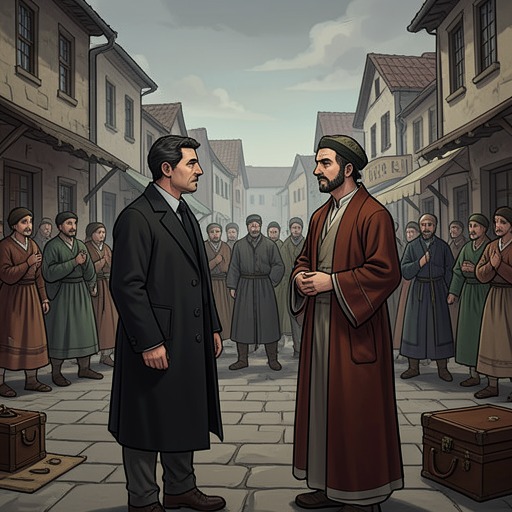
You Only Live TwiceHonour and Dishonour in the Japanese Context is a moral framework repeatedly invoked in You Only Live Twice to explain obligations that may outweigh personal safety, political convenience, or even a spoken promise. Through Tiger Tanaka’s arguments and James Bond’s resistance, the novel presents honour as both a source of social standing and a demand for atonement. Its meaning shifts with the scale of the obligation: a student’s perceived failure burdens his family, a defeated country carries a debt to expiate, and an intelligence chief must choose between a treaty, an ally, and a private debt. The exchanges make honour less a settled rule than a force whose competing claims drive the action.
A Contested Moral Vocabulary
The concept first becomes explicit in a dispute over intelligence. Bond objects that Japan is withholding vital material despite its treaty of friendship and trade with Britain. Tanaka answers that passing it on could violate assurances given to Japan by its American friends: honour, in this case, may require keeping faith with one ally rather than disclosing information to another. Bond challenges the practical value of a version whose source has been concealed, arguing that the message’s origin is part of what makes it useful. He also stresses the danger to Britain and the hours it may lose in preparing a response. Their disagreement is therefore not simply between honour and dishonour, but over which relationship creates the stronger duty and what consequences follow from observing it.
The novel connects honour to Face, the standing a person or family holds in their community. Tanaka explains this connection through the case of an eighteen-year-old student who had twice failed his university examination. During construction near his home in Tokyo, the student went onto the site and placed his head beneath the block of a working pile-driver. Tanaka describes the death as an act of expiation for the dishonour the student believed he had brought upon his parents and ancestors, and says that the boy and his family would gain Face in their neighbourhood. The concrete violence of the scene exposes the cost of treating personal failure as a debt that can be paid with one’s life.
Bond rejects Tanaka’s account as a moral justification. He argues that the student could have pursued a lower examination or another grade of college; in Britain, failure would prompt readjustment rather than self-destruction. To Bond, suicide would be cowardly because it refuses to withstand reverses and would cause pain rather than satisfaction to parents and ancestors. Tanaka counters that, for those he calls old-fashioned, dishonour must be expunged and offering one’s life is the most sincere apology. He says that the student’s family and neighbours would rejoice, and insists that honour can rank above life. The clash shows that the same death can be read as waste or atonement depending on the moral community interpreting it; Tanaka’s account describes a cultural ideal, while Bond refuses to accept that ideal as an adequate ethical answer.
Defeat, Debt, and Personal Atonement
Tanaka’s own account of honour is rooted in a different kind of reckoning. When Bond accuses him of withholding vital intelligence, Tanaka turns from the diplomatic argument to his memories of England. He recalls that the English treated him well and judges his wartime repayment of that kindness to have been unworthy. He invokes youth and the heat of a war in which he expected glory for his country, then acknowledges Japan’s defeat. The atonement for that national dishonour, he says, belongs to the country’s youth and remains a large, unresolved matter; he is not a politician and does not claim to know what course it will take.
He separates that public reckoning from his own private account. Tanaka says he is deeply indebted to Britain and that he has betrayed a state secret that morning partly because of his friendship with Dikko, but also because Bond has shown sincerity and honesty in carrying out his duty. His action is not presented as a simple reversal of allegiance: he recognizes that he has disclosed protected information, yet understands the information’s importance to Britain and weighs that act against earlier obligations. Honour here concerns not only obedience to a state but the attempt to repay a personal and historical debt.
The Disclosure and Its Limits
The exchange leaves both men bound by promises. Bond says he has given his word of honour and is urgent to avoid betraying it. Tanaka asks him to confirm that he will not communicate the intelligence elsewhere, and Bond agrees. The restriction preserves the secret even as its disclosure has already crossed a boundary: Tanaka has chosen to let Bond know it, while requiring him not to pass it on. The scene makes trust an active constraint rather than a ceremonial gesture. Bond’s word matters precisely because the intelligence could serve Britain if transmitted further, and Tanaka’s decision depends on believing that Bond will accept the limit.
Tanaka’s manner changes as he explains his motives. His face first loses its brightness and settles into melancholy while he recounts his debt; after rising and offering Bond his hand, his smile returns without pretence. He calls honour a pattern of behaviour and gives the image of bamboo bending to a breeze and cedar bending to a typhoon. The image frames flexibility not as the absence of principle, but as the capacity to answer circumstances in which a duty becomes more compelling than words. Tanaka tells Bond that sometimes duty must prevail over what has been said. That principle explains how he can treat the disclosure as necessary while still binding Bond to silence.
The Test of British Honour
Honour also shapes Tanaka’s judgment of Britain. Before revealing his mission, he gives Bond a severe account of British decline: the loss of empire, the failed intervention at Suez, governments he considers incapable of ruling, and a culture he believes has weakened its moral fibre through shirking and the pursuit of pleasure. Bond laughs at the attack, then answers that Britain has been strained by two world wars, the Welfare State, and rapid colonial liberation, but that its people still achieve distinction in climbing, sport, and Nobel Prizes. The argument turns national honour into a question of whether a country retains qualities worth trusting, rather than a simple measure of past power.
Tanaka admits that the assault was deliberate. He had wanted to see whether Bond’s famous English stoicism would break under pressure, and says that he had made a similar case to the Prime Minister. The Prime Minister authorized him to put Bond to a test: success would persuade him that an elite still existed in Britain and that the intelligence could be entrusted to British hands; failure would mean politely refusing the request. Tanaka then tells Bond that he must enter the Castle of Death and slay the Dragon within. The mission is thus made a trial of personal conduct and national standing at once. The intelligence question that began with treaties and competing allies ends in a demand that Bond prove, through action, that Britain remains worthy of trust.